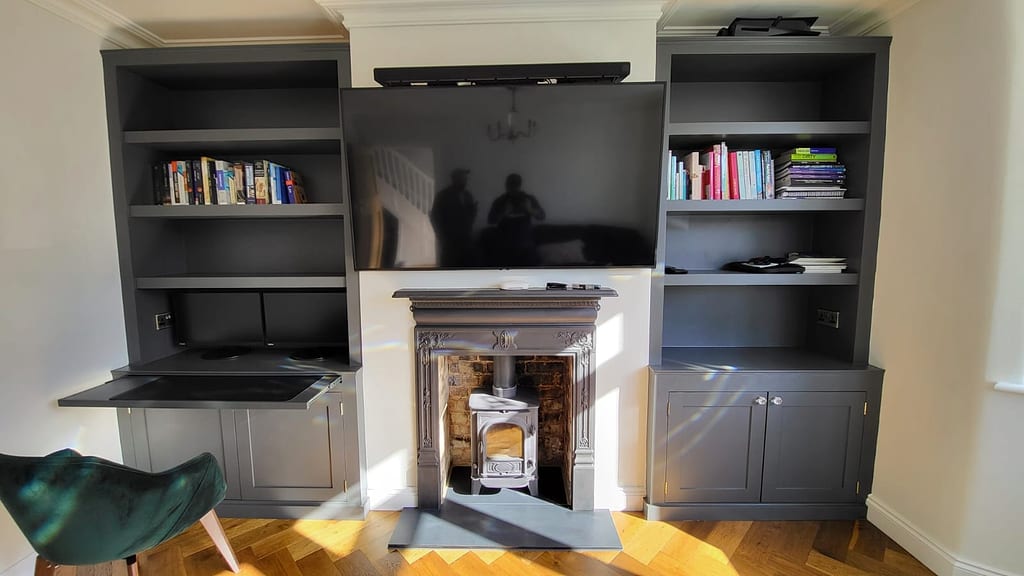
A common conversation we have at the site survey: “Should we do alcove cupboards or just open bookshelves?” The honest answer is that they’re for different purposes and pretending otherwise is the source of the common regret pattern — clients commit to one direction, finish the room, and find out 18 months later that the other would have been the better call.
This post is the framework we walk clients through to decide.
What each one is actually for
Bookshelves are for displaying objects. The visual content of the room is what’s on the shelves — books, ornaments, framed photos, the sentimental objects from twenty years of accumulation. The shelving structure is a frame around that content.
Alcove cupboards are for storing things you don’t want to see. Closed doors hide whatever’s behind them; the visual content of the room becomes the doors themselves and the proportions of the cabinet. The cabinet face is a clean architectural feature.
The mistake is using either one for the wrong purpose:
- Bookshelves used for storage (so they end up cluttered with random objects, which looks like clutter)
- Closed cupboards used for display (so they sit empty visually, which looks like a missed opportunity)
When to pick alcove cupboards
Five situations where closed alcove cupboards are the right call:
1. You don’t actually have enough display-worthy objects. This is the most common one. If you’d be filling 70% of the shelves with random items just to fill the space, you don’t have a display-content problem; you have a storage problem.
2. The room is already visually busy. Period homes with cornicing, picture rails, dado rails, fireplace surrounds and decorated ceilings already have a lot going on. Open shelves add another visual layer that can tip the room into “fussy”. Closed cupboards calm the room down.
3. The storage need is significant. If you have a real volume of stuff that needs to live in the alcoves — board games, drinks, art supplies, anything not for display — closed cupboards give you 100% storage utilisation. Open shelves only work for items you want visible.
4. You don’t dust regularly. Open shelves accumulate dust at 3-5× the rate of closed cupboards. If you’re realistic about your relationship with feather dusters, closed is the lower-maintenance answer.
5. You’re styling the room for resale or photography. Closed cupboards photograph cleaner than open shelves. If selling the house is in the medium-term plan, closed is the safer bet for the listing photos.
When to pick bookshelves
Equally, five situations where open shelves are the right call:
1. You’re an actual reader / collector. If you have hundreds of books, or a serious collection of objects (ceramics, vinyl, photography), open shelves are how you live with that collection day-to-day rather than burying it.
2. The room is visually quiet. Modern minimalist interiors, or rooms where the walls and floor are doing most of the visual work, want some content. Open shelves provide it.
3. You want the chimney breast to read as a focal point. Closed alcove cupboards tend to compete with the chimney breast for visual weight; open shelves frame it instead. If the fireplace is the room’s hero, open is the right complement.
4. The ceiling is high. Tall rooms (3m+) need vertical visual content. Floor-to-ceiling open shelves provide it more cheaply and more flexibly than floor-to-ceiling cupboards.
5. Your style is “cosy” rather than “minimal”. Open shelves with books, photos and objects read as lived-in. They’re often what makes a house feel like a home rather than a showroom.
The hybrid (and why it works)
The single most-built configuration in our portfolio isn’t “all cupboards” or “all shelves” — it’s the hybrid: low closed cupboards (to about 1m tall) with open shelves above. The bottom hides the storage you don’t want to see; the top displays what you do.
This pattern works for about 70% of our alcove projects. Costs roughly the same as full-height closed cupboards (small saving on hardware, small cost for shelf brackets and exposed-edge MDF). Look slot-into rooms of any era. Are easier to live with than either extreme.
What it costs (London 2026)
| Configuration | Typical range per pair |
|---|---|
| Open bookshelves only (no closed storage) | £900–£1,400 |
| Low closed cupboards + open shelves above | £1,400–£2,200 |
| Full-height closed alcove cupboards | £1,800–£2,800 |
Open shelves are cheaper because there are no doors, no hinges, no soft-close hardware. They look more expensive than they cost; closed cupboards cost more than they look like they cost.
The reversibility question
A common question: “Can we change our mind later?” Yes, mostly. Closed cupboards can have doors removed (1-2 day job, £150-£300 per pair). Open shelves can have doors added but it’s a bigger conversion job because face frames and hinge points have to be built in — figure £400-£600 per pair. So closed-to-open is the cheaper reversal direction.
In practice, fewer than 5% of clients reverse direction. The conversation we have at the site survey usually lands on the right answer for the room.
If you’re still not sure
The single best diagnostic question we ask clients: “Walk us through what you’d put on the shelves.” If the answer comes easily and specifically — books, the ceramic collection, your photography prints — open shelves are right. If the answer is “ummm… general stuff?” — closed cupboards are right.
For more on what bespoke alcove units cost across the configurations above, see our alcove units service page and the cost-of-fitted-alcove-units post.