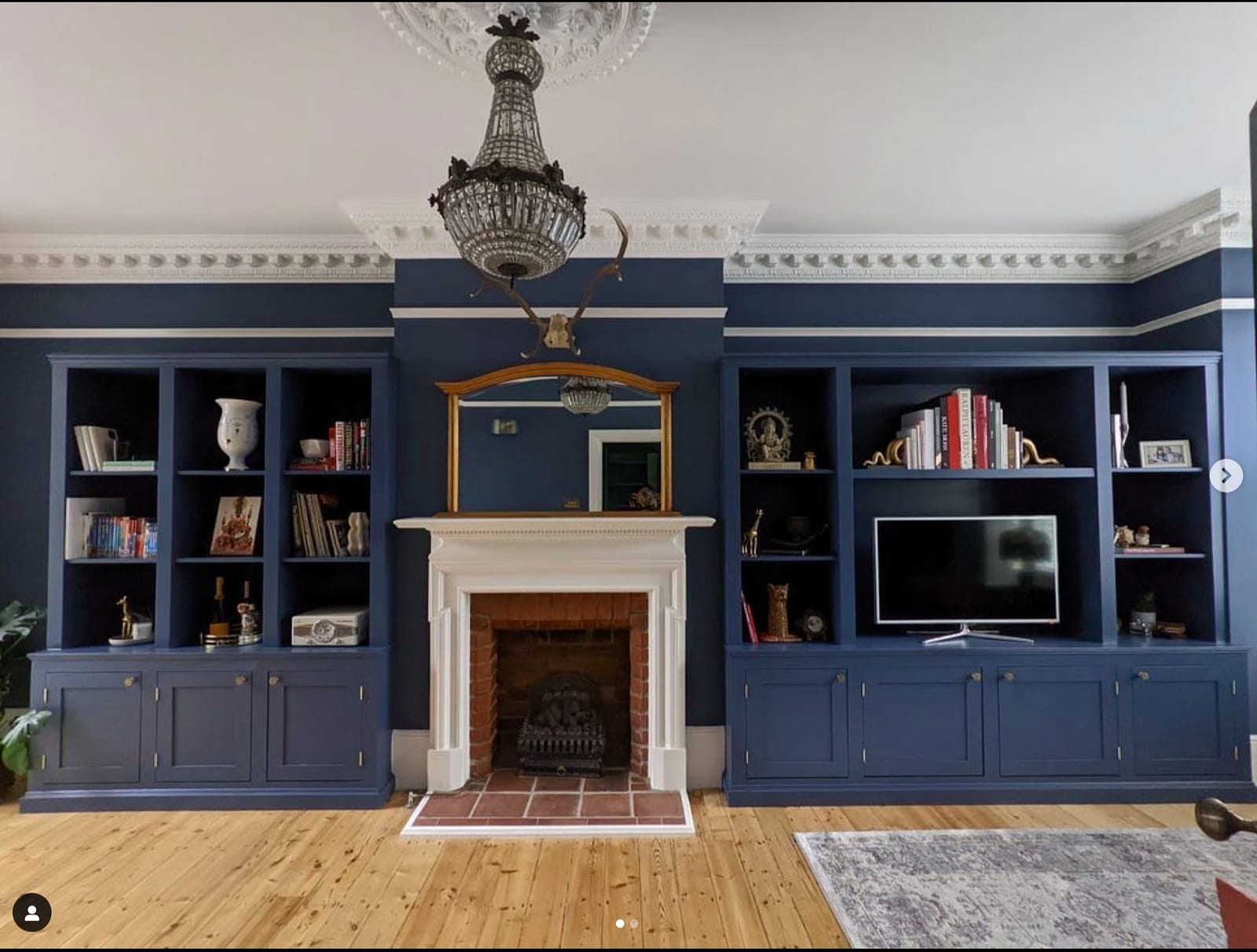
What a media wall actually is, vs a “TV unit”
A “TV unit” is a piece of freestanding furniture that holds a TV. A media wall is a built-in cabinet system that frames a wall-mounted TV with surrounding storage. The difference matters because the design choices are completely different. A freestanding TV unit is sized to the TV and bought as a finished item; a media wall is sized to the room first, and the TV becomes one component within the wall’s overall composition.
Every media wall we build starts with the same survey: how wide is the wall, how high is the ceiling, where do you sit, what’s the TV size, what’s behind the wall (this matters for cable runs and structural fixings), and how does light fall on the TV during the day. The cabinet design comes from those answers, not the other way round.
Where cables go, and why that’s the hardest part
In a typical 2025 living room a TV needs: power, HDMI from a console or two, HDMI from a soundbar, sometimes Ethernet, sometimes a TV antenna or aerial feed, and sometimes a phono lead for audio out. That’s five to seven cables. The whole point of a media wall is that none of them are visible.
The cleanest way to handle this is to build a double-partition: the TV mounts on the front face of the cabinet, behind that face is an 80–120mm cavity, and all cables run vertically inside the cavity. At the bottom there’s an inspection panel — usually disguised as the cabinet’s kick-board — that opens to let you pull new cables through without dismantling anything else. This adds about £500–£800 to the cost of a standard media wall but makes the rest of the cabinet’s life much easier.
Lighting, fires, and where we draw the line on AV
We do the cabinet, the cable routing, and any low-voltage lighting that lives inside the structure (shelf LEDs, picture lights). For new mains spurs (e.g. adding a socket behind the TV where there wasn’t one) we bring in a Part-P registered electrician we work with regularly; their cost is itemised separately on the quote. For installing the TV and tuning the audio system, we mount the TV on the day of fit so you can see the alignment is right, but we don’t do AV configuration — that’s the realm of a dedicated home cinema fitter, who we can recommend if you need one.
For electric fires: the modern Dimplex / Acantha range fits into a recess cut into the cabinet and runs on a standard 13A socket — no flue, no venting. We’ve fitted dozens of these into media walls. Real wood-burning or gas fires require a flue and are out of scope for media-wall work; if you want one of those, the media wall design has to work around it, not include it.
The “should we move the sofa?” question
The biggest non-cabinet variable in a media-wall design is your viewing distance. The sweet spot for a 65” 4K TV is about 2.5–3m of viewing distance; for a 75” it’s 3–3.5m. If your sofa is closer than that, the TV will feel oversized; further and the screen will feel small. We measure the seating-to-wall distance at the survey and will tell you honestly if your TV is wrong for the room before we even talk cabinet design.