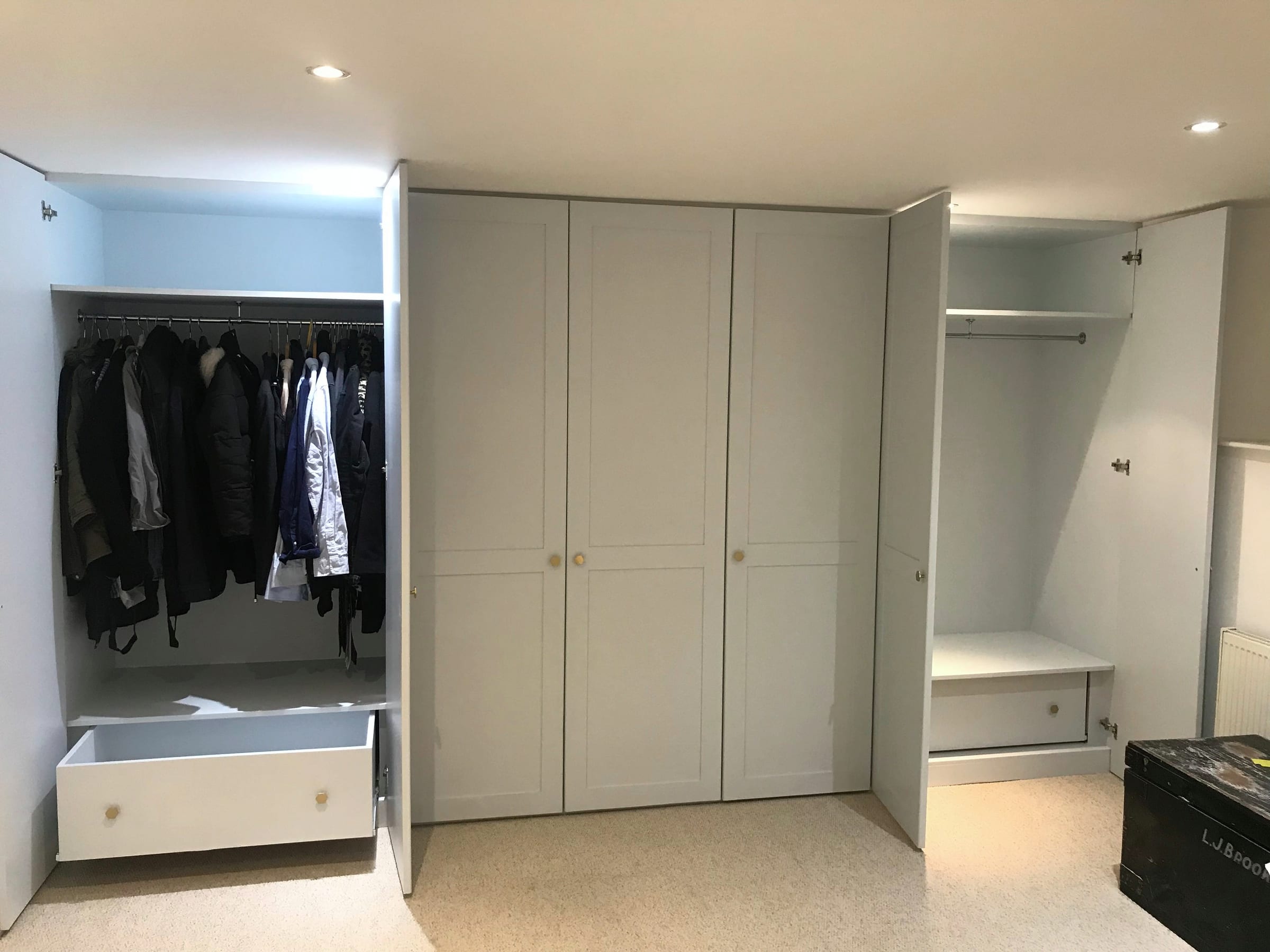
Commissioning bespoke joinery is one of the higher-cost decisions you’ll make in your home that doesn’t come with the regulatory protections of, say, a building project. Anyone with a saw can call themselves a joiner. Below are the six questions we’d suggest asking any prospective joiner before signing — and three red flags worth walking away from.
Six questions to ask
1. Can you walk me through a recent project you completed, start to finish?
A real joiner will have a portfolio of recent work and can talk about the specific brief, the constraints, what changed during the project, and the outcome. If they can’t describe a recent project in detail, or if every project they describe sounds generic, that’s a tell.
2. Where will the workshop work happen?
Three legitimate answers: (a) “We have our own workshop in [location]” — best case. (b) “We rent workshop space at [shared facility]” — also fine. (c) “We work on-site at your home” — also a legitimate model, but limits the quality of finishing (no spray booth, no controlled environment for painting). What you’re listening for is that they have a clear answer; “we’ll figure that out later” means they’re not actually a joiner.
3. Who else will be in my house during the install?
You want: the same people who surveyed your house, plus possibly one or two team members from the same workshop. You don’t want: subcontracted installers the joiner has never worked with, day labourers hired for this project, or a different team than the survey people. The continuity matters because the install team needs to understand the joinery’s intent.
4. What hardware will you use? Brand names please.
A legitimate joiner will name specific brands — Blum, Häfele, Hettich for hinges and runners; Egger or Kronospan for carcass materials; named paint brands for finishes. If you get vague answers (“good quality hinges”, “industry-standard hardware”) that’s a flag. Real joiners know the hardware they buy.
5. How is payment structured?
The standard schedule we’d recommend is 30% on order acceptance (so materials can be ordered), 50% on workshop completion (so you can verify the work is built before it’s at your house), 20% on practical completion. Variations exist (50/50 for small projects is fine; some joiners do 25/50/25). What you don’t want is large up-front deposits (over 50%), no schedule documented in the quote, or cash-only requests.
6. What’s the guarantee?
Twelve months on workmanship is standard. Hardware guarantees are usually manufacturer-direct (Blum is lifetime). Make sure the guarantee is in writing on the quote. If “we don’t really do paperwork” comes back, that’s also a flag.
Three red flags to walk away from
Red flag 1: Quote provided without a site survey.
Any joiner offering a fixed quote based on photos or measurements you provided — without coming to look at the room themselves — is going to be wrong. Either the price will be padded to cover unknowns, or there’ll be a “we found something” conversation halfway through where the price goes up. Free site surveys aren’t free out of generosity; they’re how the joiner gets the information they need to quote accurately. Insist on one.
Red flag 2: Cash-only or wire-transfer-only with no invoice.
Cash isn’t a flag in itself; lots of small businesses (us included) take bank transfer rather than card. What’s a flag is the absence of an invoice or proper documentation. Every legitimate joiner can give you a VAT-registered invoice with their company details. If you can’t get one, you can’t claim guarantee.
Red flag 3: Lead-time pressure (“if you sign today…”).
Bespoke joinery has 3-12 week lead times depending on scope. A joiner pressuring you to sign within hours is either selling something you don’t need (rare) or covering for the fact that they don’t have the workshop capacity but want to lock you in before you find another quote (common). A few days to think about it is reasonable to ask; if they can’t accommodate that, walk away.
What you should be comparing across quotes
When you have your two or three quotes, the comparison should look at:
| Variable | What to check |
|---|---|
| Total price including VAT | All quotes on the same VAT basis |
| Hardware brand | Same Blum/Häfele tier across all? |
| Carcass material | All MFC, or some MDF? |
| Door construction | Five-piece, single-panel, or in-frame? |
| Number of site days | Realistic for the scope? |
| Workshop lead time | 3-8 weeks normal, longer is fine if scope justifies |
| Guarantee | 12 months minimum in writing |
If two quotes are close on these and the third is materially cheaper, the third is almost certainly using cheaper components.
When the recommendation is “go elsewhere”
We’ve recommended other joiners to clients before. Usually for one of three reasons: (1) the project is outside our service area (e.g. north-west London, which we don’t really cover); (2) the project is much bigger than we can take on without compromising other work; or (3) the client’s brief is for something we’re not the right specialists in (very high-end kitchens, for example).
We’d rather give you a name of someone else than take on work we won’t do well. If you’re commissioning a project from us, you should expect the same honesty in the other direction — we’ll quote on what we’re good at and decline the rest.
For a free site survey across East London, get in touch.