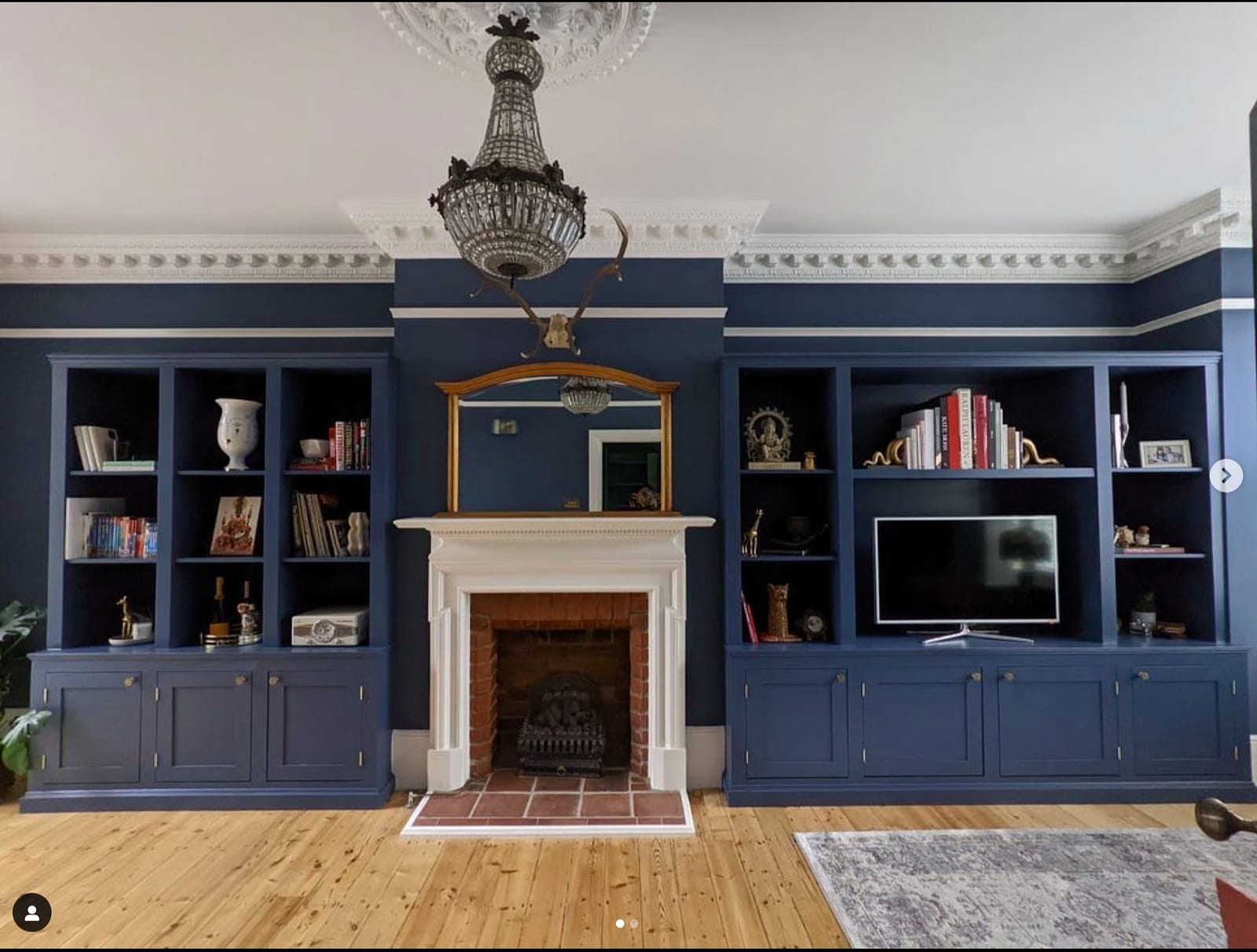
A “media wall” can mean a dozen different things. Below are the twelve directions we’ve used most often in London living rooms, with notes on which works in which room type and why.
1. Minimal recess
A single rectangle cut into a flush cabinet face, with the TV mounted inside. Cabinet either side is a single uniform face — no doors, no shelves, just a clean wall. Best for small modern living rooms (under 4m wall width) where any visual complexity would compete with the rest of the room.
2. Full-height with flanking floor-to-ceiling storage
The classic. TV in the centre, full-height cabinetry on each side with closed-shaker doors. Storage hidden behind the doors, often used for books, board games, occasional AV gear. Works in any wall width 3m or wider; the most-built version in our portfolio.
3. Asymmetric storage
TV off-centre (often to one side of the chimney breast), with substantial closed storage on the opposite side and minimal cabinetry under the TV. Good for rooms where the chimney is being kept as a feature rather than incorporated.
4. Floating shelves around the TV
TV mounted directly on the wall (or in a shallow recess), with floating painted shelves at picture-rail height running across the wall above. No closed storage. Cheapest entry point into the “media wall” idea and works surprisingly well when the room already has plenty of storage elsewhere.
5. Chimney-breast bridge
For rooms with a chimney breast already in the way of the TV wall — a closed-storage bridge runs across the top of both alcoves and over the chimney breast, with the TV recessed into the chimney face. The chimney becomes part of the cabinetry. See our Wanstead media wall project for the type.
6. Pair of alcove cabinets + TV on chimney breast wall
A simpler variant of #5 — alcove units either side, but the TV mounts directly on the chimney breast itself (not recessed). Cabinet faces stop at the chimney breast. Cheaper to build than the full bridge and lets the chimney breast keep its visual identity.
7. With integrated electric fire
A media wall incorporating one of the modern frameless electric fires below the TV. The fire requires only a 13A socket — no flue. Popular when the room had a real fireplace that was removed and the chimney is now non-functional but still architecturally present.
8. Hidden TV (lift-up panel)
For clients who want to look at the wall and not see a TV at all — a painted shaker panel hides the TV; a small lift mechanism (Linak or similar) raises the panel when the TV is in use. Significantly more expensive (£800–£1,500 premium for the lift) and slow to operate. Works for some.
9. With floor-level kick-out for soundbar
Soundbar mounted on a pull-out shelf at the base of the cabinet that retracts when not needed. Tidy for rooms where you’d rather see the cabinet face than a permanent soundbar shelf. Particularly common when the room is photographed for sale or for guests.
10. Library wall with TV embedded
The whole wall is a library — open shelves in painted MDF — with the TV embedded in one of the shelf bays. Books surround the TV. Best for clients who actually have a lot of books; without the books it looks empty.
11. Inset alcoves for AV with no TV
A wall with display alcoves cut into a flush painted cabinet, used for objects rather than a TV. The “media wall” idea but for clients who don’t want the TV in the living room (often when the TV lives in a snug or den elsewhere).
12. Two-zone wall (sitting + TV)
For longer living rooms — one half of the wall is a media wall with TV; the other half is a desk / study zone tucked into a closed cabinet. The wall reads as one piece of joinery; the uses are different. Works well in open-plan kitchen-diners where the living zone is the smaller end.
How to choose between them
Three questions worth asking yourself before commissioning:
- What’s the wall width? Under 3m wall — go for #1 or #4 (minimal). 3-4m — #2, #3, #6, #7 work. 4m+ — anything from #2 to #12 is in range.
- Is there a chimney breast already? If yes, #5, #6, or #7. If no, the field is open.
- How much storage do you actually need from this wall? If a lot — #2, #3 or #10. If almost none — #1, #4, or #11.
For more on what bespoke media walls cost and what’s in the typical scope, see our media walls service page. Or get in touch for a free site survey.