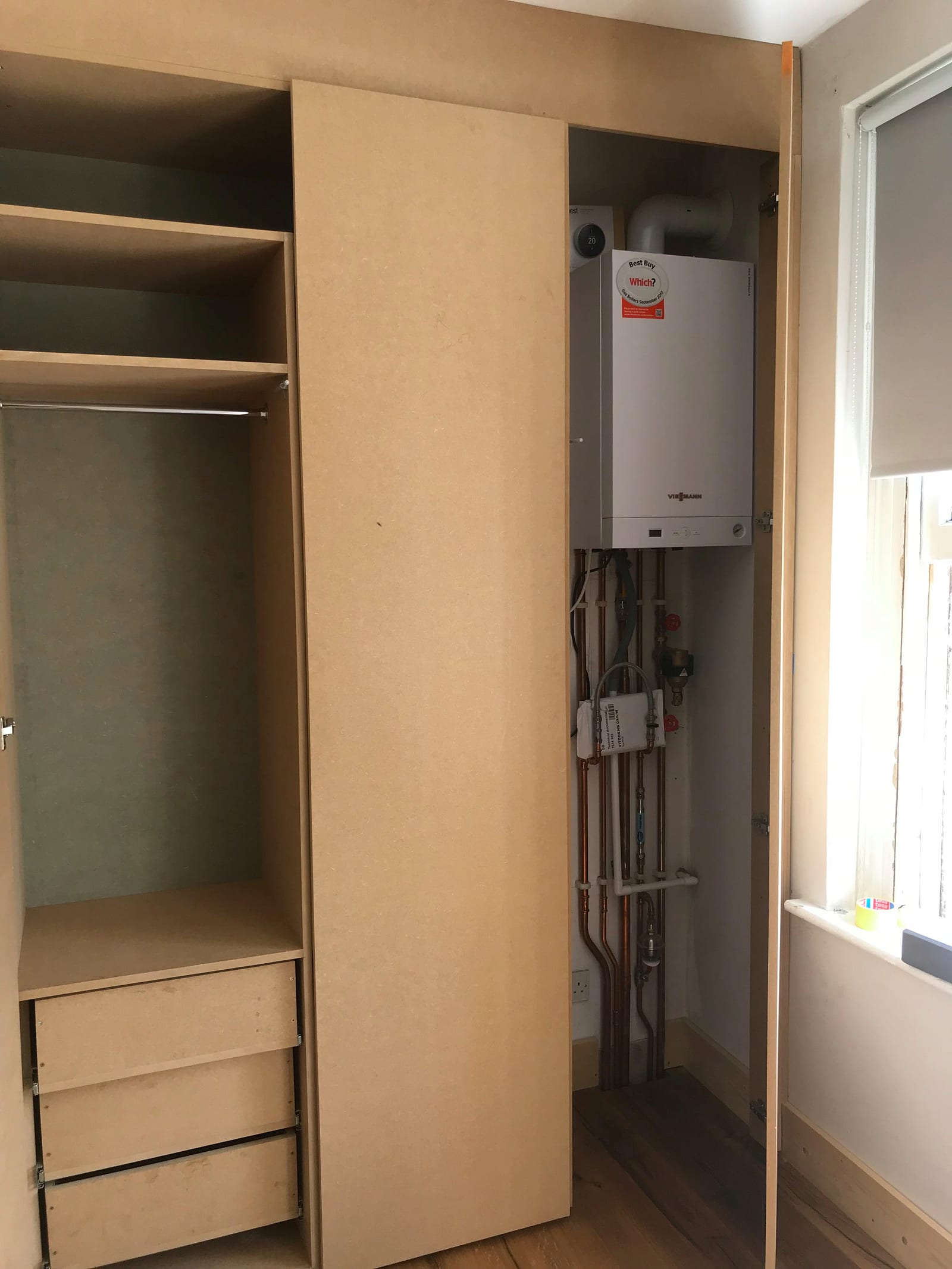
Small bedrooms are the case where bespoke wardrobes most obviously beat off-the-shelf. In a generous master bedroom, IKEA Pax with a scribe panel is a perfectly reasonable choice; in a 9m² London bedroom, the few extra centimetres bespoke buys you can mean the difference between a wardrobe you can use and one you can barely close.
The three small-bedroom variables
Three things determine what’s possible in a small bedroom:
Available wardrobe wall length. Below 1.2m you’re in single-bay territory. 1.2–1.8m is two-bay range. 1.8–2.4m gives you proper three-bay with mixed interior. The available wall length is what it is; you can’t manufacture more of it.
Ceiling height. A 2.4m ceiling vs a 2.8m ceiling is a significant difference in vertical storage. In small bedrooms with high ceilings, going floor-to-ceiling adds 25–40% more storage capacity for very little extra cost.
Bed-to-wardrobe distance. Determines whether hinged doors are viable. Less than 700mm and you’re looking at sliding doors; more than that and hinged is the better (cheaper, more accessible) option.
Compact wardrobe tricks we’ve used
Five design moves that buy meaningful extra capacity in small bedrooms:
Inline-facing hanging rail (Häfele Pull-Out). Conventional hanging rails span left-to-right inside the wardrobe; clothes hang at 90° to the door. In shallow wardrobes (under 450mm deep) shirts protrude beyond the door line. Inline-facing rails span front-to-back; clothes hang parallel to the door. You lose some hanger capacity but gain 100mm of usable interior width.
Drawers behind shorter hanging. If the hanging zone only needs to be 1.2m tall (shirts and trousers; no long dresses), the space below can be drawers rather than the conventional shelves-or-shoe-floor. Adds significant capacity for folded items.
Floor-to-ceiling. Almost always worth doing in small bedrooms. The upper 400-600mm above the conventional 2.1m wardrobe height becomes long-term storage (suitcases, boxed shoes) accessed by a small step or library ladder. Doubles the suitcase storage problem.
Mirror panel inside one door. Saves the floor space a standalone mirror would take. Internal door-mounted mirrors are about £80-£140 to add to an existing wardrobe spec.
Single-bay with three zones. A 560mm-wide alcove wardrobe can still have three useful interior zones — hanging at top, drawers in the middle, fold-out ironing flap at the bottom. See our Clapton Pond compact wardrobe project for the type.
Sliding vs hinged
The single biggest decision in a small bedroom. Quick guide:
| Situation | Recommendation |
|---|---|
| Bed close to wardrobe (<700mm) | Sliding |
| Bed far from wardrobe (≥700mm) | Hinged (cheaper, fuller access) |
| Want full-length mirrored panel | Sliding (mirror as door panel) |
| Want maximum interior visibility | Hinged (you can see everything at once) |
| Budget-driven | Hinged (~25% cheaper) |
Note: sliding-door wardrobes also tend to be the right answer for very wide single-bay wardrobes (1.6m+) where a single hinged door would be too heavy and a pair of doors would look awkward.
Sloping ceilings
Common in London upstairs bedrooms (especially over rear extensions). Off-the-shelf wardrobes can’t handle them at all — they’re flat-topped. Bespoke handles the slope by scribing each panel individually.
Two usual approaches:
Match the slope. Wardrobe top edge follows the ceiling pitch. Looks intentional and uses every cubic centimetre. The low end of the wardrobe is used for drawers (which work well at shorter heights); the high end has hanging.
Cap below the slope. Wardrobe stops at a flat top edge below where the slope starts. Easier to build, slightly less storage capacity, gives a cleaner horizontal line if the room benefits from one.
We do the slope-following version about 80% of the time; cap-below the other 20% (usually when the slope is gentle enough that the headroom saved isn’t significant).
The mirror question
Three places to put a mirror in a small bedroom:
- Inside the door (cheapest, takes no floor space, but only visible when wardrobe is open).
- As an external panel on the wardrobe side (visible always, no extra wall space needed; £180-£280 to add).
- As a sliding-door panel (the most architectural option, see #2 in the sliding/hinged section above; £400-£700 premium over plain panels).
Most small bedrooms benefit from option 2 — full-length mirror on the cabinet side, visible from across the room. The Ealing project is built around exactly this configuration.
When to give up on bespoke
If your bedroom is 2.4×2.4m and the only wardrobe wall is 2.2m wide, IKEA Pax plus a scribe panel will work fine and save you £1,200–£1,500. We’ve recommended that route a few times in small Victorian conversion flats. The Pax-plus-scribe loses about 15% of available storage vs bespoke but the cost difference may not be worth chasing.
For anything tighter than that — narrow alcoves, sloping ceilings, irregular shapes — bespoke wins, even in 7-9m² rooms. Get in touch for a free site survey.